

Your menstrual cycle can feel confusing. Hormones. Phases. Ovulation. Fertile windows. It’s a lot.
Let’s break it down in the simplest way possible.
Think of your cycle as your body’s monthly preparation for a possible pregnancy. Even if you’re not trying to get pregnant, your body still goes through the same steps each month.
The Big Picture: What Is the Menstrual Cycle?
Your menstrual cycle is more than just your period.
It’s a repeating pattern that:
- Grows and releases an egg from the ovaries
- Prepares your uterus for pregnancy
- Resets if pregnancy doesn’t happen
A typical cycle lasts about 28 days, but anywhere from 25–35 days can be completely normal.
Who’s in Charge? (The Hormone Team)
Your brain and ovaries work together in a communication loop. This system is called the HPO axis (hypothalamic-pituitary-ovarian axis), but you don’t need to memorize that.
Here’s what matters:
- Your brain sends signals
- Hormones like estrogen and progesterone rise and fall
- Your body responds: the ovaries grow and release an egg while the endometrium thickens in preparation
It’s like a monthly text thread between your brain and ovaries.
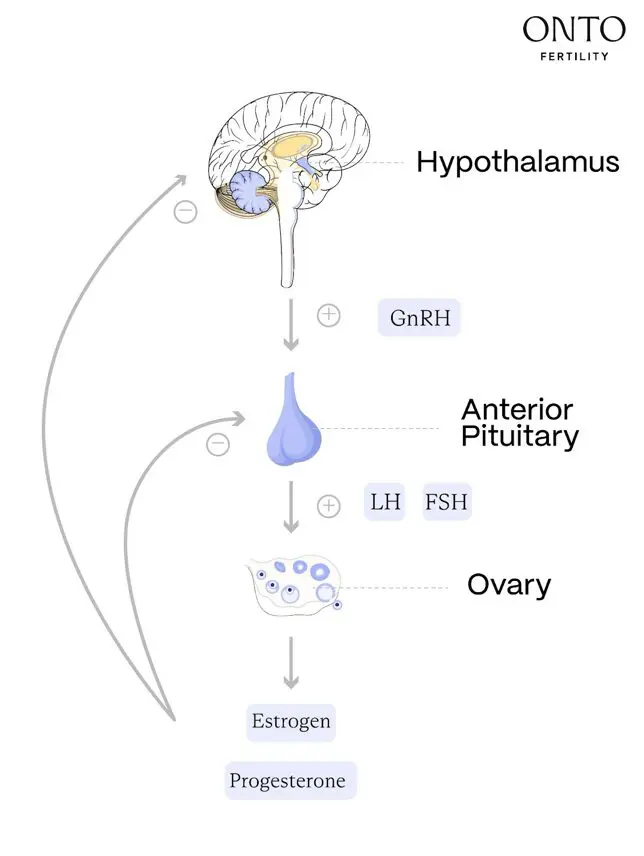
HPO Axis
The 3 Main Parts of Your Cycle
1. The Follicular Phase (Day 1 → Ovulation)
Day 1 is the first day of your period.
During this phase:
- Your period happens (shedding last month’s lining)
- Your ovaries start maturing several tiny follicles (each holds an egg)
- One egg becomes “dominant”
- Estrogen rises and thickens your uterine lining
This phase can vary in length, and most cycle differences happen here.
2. Ovulation (The Main Event)
Around the middle of your cycle, your body releases one egg.
This happens because of a hormone surge called LH.
What to know:
- The egg lives only 12–24 hours
- It travels into the fallopian tube
- This is when pregnancy can happen
Ovulation usually occurs about 14 days before your next period starts, not always on Day 14.
Fun fact: Most of the time, the ovaries release only one egg each month. But if two or more eggs are released and fertilized in the same cycle, the result could be natural multiples, such as twins or triplets.
3. The Luteal Phase (After Ovulation → Next Period)
Now your body waits.
- Progesterone rises to support a possible pregnancy
- If pregnancy doesn’t happen, hormones drop
- Your period begins
- The cycle starts again
This phase is usually about 12–14 days and is more consistent month to month.
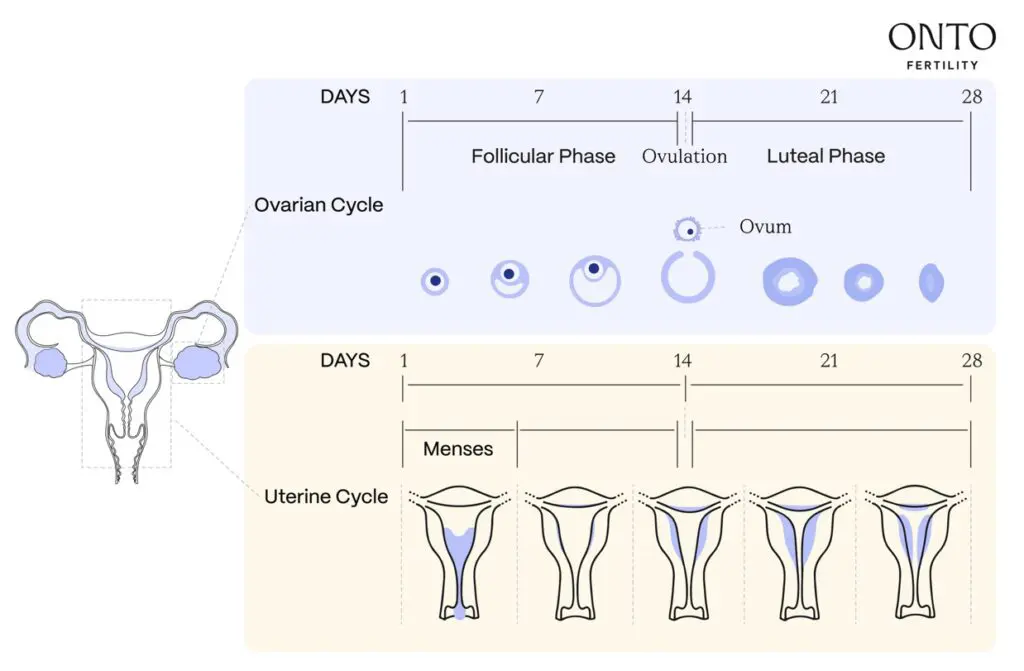
Cycle Phases
What Is the Fertile Window?
Whether you’re trying to get pregnant now, planning for the future or simply want to better understand your body, it’s important to know how fertility actually works. A common misconception is that you can get pregnant at any time during your cycle. In reality, there is a relatively short window each month when pregnancy is possible. You are not fertile all month.
Your fertile window includes:
- The 5 days before ovulation
- The day of ovulation
- Possibly the day after ovulation
Why? Because:
- Sperm can live in the reproductive tract for up to 5 days
- The egg lives for about 12 to 24 hours after ovulation
That means pregnancy can only occur if sperm are present during the short time the egg is available. Understanding this timing can help you feel more informed, no matter your goal.
Signs You Might Be Ovulating
Your body gives clues. Look for:
- Clear, slippery cervical mucus (like egg whites)
- A slight rise in body temperature (after ovulation)
- Mild pelvic discomfort or bloating
- Breast tenderness
Not everyone feels obvious signs, and that’s normal.
Ways to Track Ovulation
If you want to understand your timing better, you can try:
- Calendar tracking
- Ovulation predictor kits
- Basal body temperature charting
- Monitoring cervical mucus
Tracking can help whether you’re:
- Trying to get pregnant
- Trying to avoid pregnancy
- Or just learning how your body works
The Bottom Line
Your menstrual cycle isn’t random, it follows a pattern.
Each month, your body:
- Prepares an egg
- Builds a lining
- Waits
- Resets if needed
Understanding this rhythm gives you power. It helps you make informed decisions about your fertility, contraception and overall health.
If you ever feel confused, irregular or concerned about your cycle, it’s always okay to talk with a healthcare provider. Your body deserves attention, and so do your questions.
Menstrual Cycle: Common Questions
How long is a normal menstrual cycle?
A typical menstrual cycle lasts about 28 days, but cycles between 25 and 35 days are common and considered normal.
When is the fertile window?
The fertile window includes the five days before ovulation and the day of ovulation.
Can you get pregnant at any time during your cycle?
No. Pregnancy can only occur during the fertile window when sperm are present while an egg is available.
How do I know if I’m ovulating?
Some people notice signs such as cervical mucus changes, mild pelvic discomfort, or a slight rise in basal body temperature.
Sources
This article is informed by peer-reviewed research and educational resources from leading reproductive health institutions, including the National Institutes of Health (NIH), UCSF Center for Reproductive Health, and other trusted medical organizations.
- Williams CJ. Morphology and physiology of the ovary. In: Feingold KR, Anawalt B, Boyce A, et al, eds. Endotext. South Dartmouth, MA: MDText.com; 2012. https://www.ncbi.nlm.nih.gov/books/NBK278951/
- Thiyagarajan DK, Basit H, Jeanmonod R. Physiology, menstrual cycle. In: StatPearls. Treasure Island, FL: StatPearls Publishing; 2022. https://www.ncbi.nlm.nih.gov/books/NBK500020/
- University of California San Francisco Center for Reproductive Health. The menstrual cycle. https://crh.ucsf.edu/about-fertility/normal-menstrual-cycle
- Cleveland Clinic. Basal body temperature method and ovulation tracking. https://my.clevelandclinic.org/health/articles/21065-basal-body-temperature
- Mayo Clinic. Basal body temperature for natural family planning. https://www.mayoclinic.org/tests-procedures/basal-body-temperature/about/pac-20393026
- Healthline. Follicular phase of the menstrual cycle. https://www.healthline.com/health/womens-health/follicular-phase
- Rupa Health. Hypothalamic–pituitary–ovarian (HPO) axis dysfunction: lab testing, diagnosis and treatment. https://www.rupahealth.com/post/hypothalamic-pituitary-ovarian-hpo-axis-dysfunction-lab-testing-diagnosis-and-treatment