
Fertility Education Center
Resources and Expert Guidance
At Onto Health, we want to help you feel informed and supported on your fertility journey. Here you’ll find a growing collection of educational articles and resources designed to help you learn more about fertility and explore topics discussed during appointments.
Fertility Articles & Education
Having reliable, evidence-based information makes it easier to navigate your options and make decisions about your reproductive health. We’ve provided educational articles from our clinicians, written in simple terms, so you can learn directly from our team.

Fertility Treatment Medications: A Patient Guide
Being suddenly handed a medication list can feel overwhelming. Here’s the good news: most...

PMOS Explained: Symptoms, Diagnosis, Fertility, and What Actually Helps
By Rachael Elliott, MSN, WHNP-BC at Onto Health What is PMOS? If you’ve heard the term PMOS...

A Mental Health Guide to Coping with Infertility
Author: Gabby Pendley, MA, LCSW, PMH-C, CADCPerinatal Mental Health Program Manager,...

Men’s Sexual Health and Fertility: Is Your Sperm Healthy?
When you’re ready to have a kid, you may have questions you don’t want to ask out loud. That’s...

A Guide to Using Donor Eggs, Sperm and Embryos
For many hopeful parents, the road to building a family doesn’t always look how they imagined. The...

Fertility Preservation: Embryo Freezing
If you’re exploring fertility treatment or thinking about preserving your fertility, you’ve...

Fertility Preservation: Sperm Freezing
Fertility preservation is not just for eggs. Sperm can be frozen too. For many people, sperm...

Fertility Preservation: Egg Freezing
Egg freezing has become a much more common conversation in recent years. Maybe you have heard...
Fertility FAQs
Frequently Asked Questions
Fertility can bring up a lot of questions and every patient’s situation is unique. This FAQ section is designed to answer some of the most common questions about fertility, infertility, testing, treatments and family-building options. You’ll find straightforward explanations that help you better understand your body, your choices and what to expect along the way.
Please consider these answers as background for future discussion. A consultation with a fertility specialist will help you understand your unique reproductive health and explore the options that may be right for you.
When should I see a fertility specialist?
It might be time to schedule a visit if:
- You’ve been trying for 12 months (under 35)
- You’ve been trying for 6 months (35 or older)
- Your periods are irregular or absent
- You have PCOS, endometriosis, fibroids or other known conditions
- You want kids later and want to understand your fertility now
- You’re pursuing pregnancy on your own or in a same-sex partnership
Many people come in just to understand their options. You don’t have to wait for something to be “wrong.”
Does fertility treatment mean I can’t get pregnant naturally?
Not at all. Many treatments simply improve timing or support ovulation. Not everyone needs IVF. Sometimes small adjustments are enough.
Your plan depends on your age, diagnosis and goals.
Are there changes I can make to help improve fertility?
Yes, several evidence-based lifestyle changes can improve fertility for people with ovaries and people who produce sperm. Maintain a healthy weight, eat a balanced diet rich in nutrients, limit alcohol and caffeine, quit smoking and reduce stress. Ensure adequate sleep (7-9 hours) to support reproductive and overall health and longevity.
What is the definition of “infertility”?
Infertility is typically defined as not conceiving after:
- 12 months of trying (under 35)
- 6 months of trying (35 or older)
It also includes individuals who need medical help to conceive, including single parents by choice and same-sex couples.
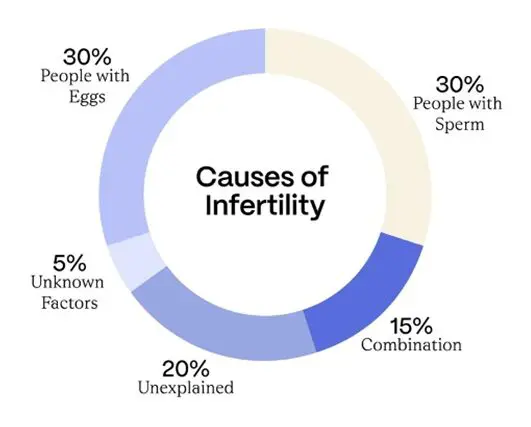
What causes infertility?
It’s common and often shared by both partners.
- About 30% egg-related
- About 30% sperm-related
- About 15% both
- About 20% unexplained
- About 5% unknown
An evaluation helps clarify what’s going on and guide next steps.
What will happen at my first appointment?
Before your visit, you’ll complete a health questionnaire and share prior records.
During your appointment, your clinician will:
- Review your history
- Talk through your goals
- Recommend next steps
Most patients leave with a clear, personalized plan.
What testing do you do?
Testing may include:
- Hormone labs
- Ovarian reserve testing
- Pelvic ultrasound
- Uterine imaging
- Genetic screening
- Infectious disease testing
- Semen analysis (if applicable)
Most testing can be done relatively quickly. Once results are available, your clinician will review findings and discuss treatment options tailored to your goals.
What fertility treatments do you offer?
Ovulation Stimulation
Ovulation stimulation uses medication to help your ovaries release an egg. It may be timed with intercourse or combined with IUI.
What’s the chance of twins?
It depends on the medication:
- Letrozole: ~5%
- Clomid: ~8%
- Injectables: higher likelihood
Your care team monitors you closely to reduce the likelihood of multiples.
What are the side effects?
Usually mild and temporary:
- Hot flashes
- Mood changes
- Bloating
- Headache
- Mild injection discomfort
Serious complications are rare.
How many cycles should I try?
Many patients try 3 to 6 cycles before reassessing the plan.
Intrauterine Insemination (IUI)
IUI places prepared sperm directly into the uterus around ovulation.
How many IUIs should I try?
Many patients try 3 to 6 cycles before considering next steps.
In Vitro Fertilization
IVF involves retrieving eggs, fertilizing them in the lab and transferring an embryo to the uterus.
When is IVF recommended?
It may be suggested if:
- Other treatments haven’t worked
- There are tubal or significant sperm factors
- Endometriosis or age-related decline is present
- Genetic testing is needed
Will IVF increase my chance of twins?
It can if more than one embryo is transferred. Many clinics prioritize single embryo transfer to reduce twin risk.
What are common side effects?
Most people experience temporary bloating, fatigue or mood changes.
A rare but important risk is ovarian hyperstimulation syndrome (OHSS). Your care team tailors medication and monitors closely to reduce this risk.
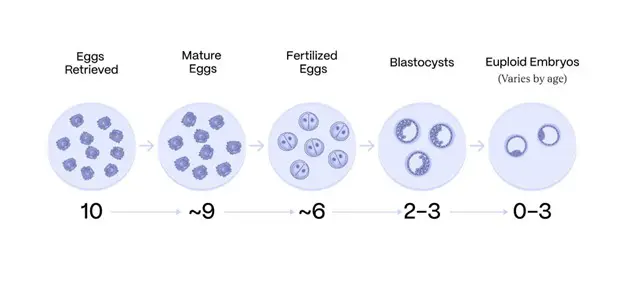
The IVF Funnel: Why Do Numbers Decrease?
Not every egg becomes an embryo, and that’s normal.
Typical progression:
- Eggs retrieved
- ~90% mature
- ~70% fertilize
- 30% to 40% reach blastocyst stage
Genetic testing may reveal that some embryos are not chromosomally normal. This is expected and doesn’t mean something went wrong. Even one healthy embryo can be enough.
 Preimplantation Genetic Testing
 Preimplantation Genetic Testing
Preimplantation Genetic Testing (PGT) evaluates embryos for genetic or chromosomal abnormalities before being transferred to the uterus.
Why do patients choose it?
To:
- Identify chromosomally normal embryos
- Test for inherited conditions
- Reduce miscarriage risk
- Make more informed decisions
It’s highly accurate, but it does not guarantee pregnancy. It’s a personal decision made with your clinician.

What is fertility preservation, and what types are offered?
Fertility preservation means freezing eggs, sperm or embryos now for possible future use.
People choose it based on age, medical treatment or life planning.
Egg Freezing
This process allows you to preserve unfertilized eggs for potential future use. It involves hormone stimulation, egg retrieval and long-term storage.
Success depends mostly on:
- Your age at freezing
- The number of eggs stored
More eggs generally means better odds. Not all eggs survive freezing.
When is the best time to start the process?
Earlier usually means better egg quality. The “right” time depends on your goals.
How long does this process take?
Usually 2 to 3 weeks from start to egg retrieval, depending on your personalized protocol. This includes 10-14 days of daily injectable fertility medications to stimulate the ovaries to mature multiple eggs instead of one. About 3 days after the last shot, eggs are collected in a minor surgical procedure under light sedation. This takes about 15-30 minutes.
Sperm Freezing
Sperm freezing is a simple way to preserve fertility for the future.
Often chosen before:
- Chemotherapy
- Surgery
- Gender-affirming care
- Travel or deployment
Storage time itself typically does not reduce the likelihood of success. Outcomes depend more on sperm quality at the time of freezing.
Embryo Freezing
Embryos are created through IVF, then frozen.
Survival rates after thaw are very high, and pregnancy rates are similar to fresh transfers.
Embryo freezing provides more predictability because fertilization has already occurred.
Tools to Help You Plan Ahead
Understand your fertility timeline with simple, interactive guidance designed to support informed decisions.
Interactive tools can help you better understand your fertility timeline and options. That’s why we’ve created a set of simple, interactive tools designed to help you learn more about your reproductive health and what your chances of pregnancy may look like.
These tools are not meant to replace medical advice, but they can give you helpful insight and a starting point for informed conversations about your fertility and family-building goals.

Fertility Quiz
Answer a few question to get personalized next step guidance.
Fertility Calculators
Explore timelines, success rates, and planning tools.