
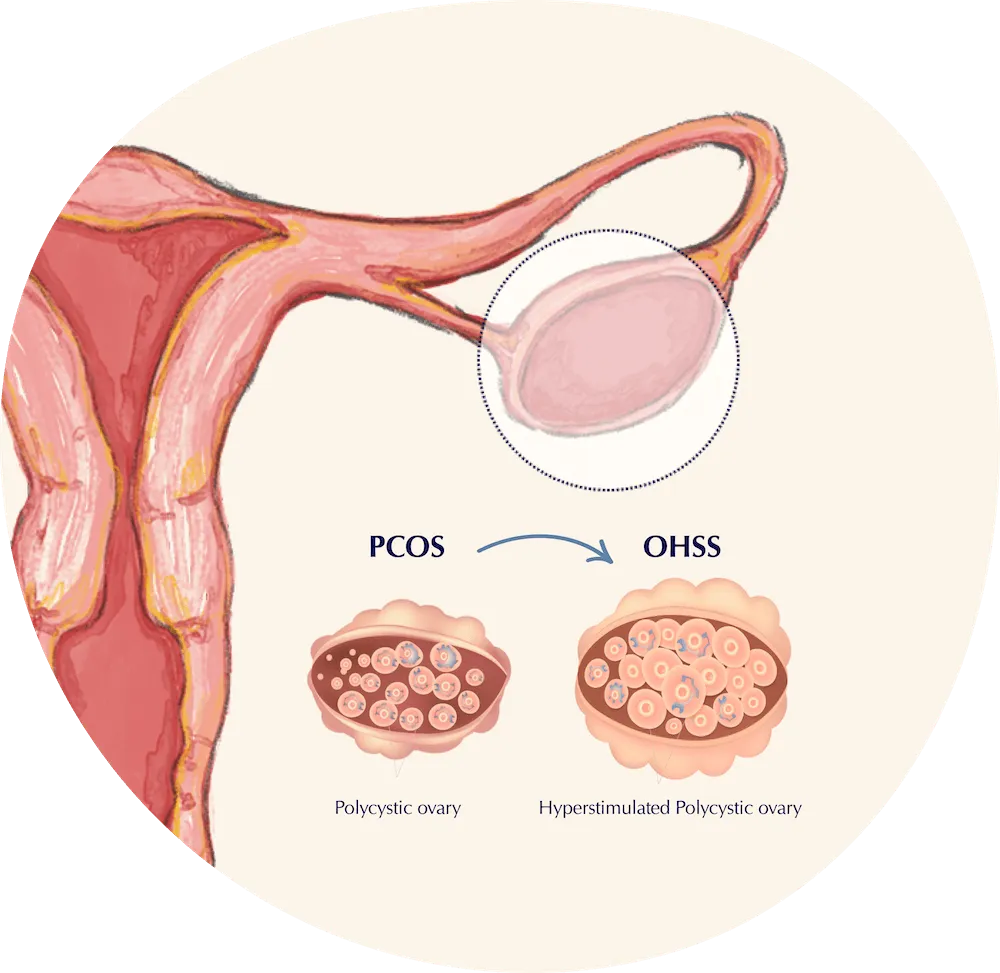
What Happens in the Body During OHSS?
In IVF, medications such as human chorionic gonadotropin (hCG) are used to help your ovaries mature multiple eggs at once. In some women, this stimulation can be excessive, causing the ovaries to swell and leak fluid into the abdomen and, in rare cases, into the chest.
This fluid shift is caused by increased vascular permeability, meaning that blood vessels become unusually leaky. The result is fluid moving out of the blood vessels and accumulating in body cavities. This can lead to bloating, abdominal pain, nausea, and in more severe cases, dehydration, difficulty breathing, and blood clots.
OHSS is classified into three types:
- Mild: Abdominal discomfort, bloating, and slight weight gain.
- Moderate: Increased abdominal swelling, nausea/vomiting, diarrhea/constipation
- Severe: Rapid weight gain, severe pain, shortness of breath, decreased urination, and blood clots.
Who is at Risk for OHSS?
Certain women are more susceptible to developing OHSS. Risk factors include:
- Age under 30
- Polycystic Ovary Syndrome (PCOS) – due to higher sensitivity to stimulation
- High Antral Follicle Count (AFC) – meaning more potential follicles to stimulate
- High levels of Anti-Müllerian Hormone (AMH) – indicating a high ovarian reserve
- Previous episode of OHSS
- Use of hCG to trigger ovulation or support the luteal phase
- High number of follicles and/or high estradiol levels at time of trigger
- High number of oocytes retrieved
Women who become pregnant in the same cycle may also experience worsening OHSS symptoms, as pregnancy increases natural hCG production, which can prolong or intensify the condition.
How AMH Can Help Predict the Risk of OHSS During IVF
The Anti-Müllerian Hormone is a hormone produced by small ovarian follicles and is often measured to assess ovarian reserve. High AMH levels generally mean a higher number of follicles and a greater response to stimulation. Research shows that AMH is one of the best indicators for predicting the risk of ovarian hyperstimulation syndrome. In fact, AMH may be even more accurate than other common markers like estrogen levels or ultrasound findings.
Different labs use different types of assays, so the “cutoff” value, i.e. the point at which risk increases, can vary. Depending on the assay, an AMH greater than 3.4 ng/mL or 5 ng/mL puts you at increased risk of OHSS. Please make sure your physician is familiar with the AMH assay used and its respective cutoff value. Typically, clinics also have in-house cutoff values for concern for OHSS that are based on their patient cohort.
At LEVY Health, we interpret your AMH according to your age and the assay used, so you’ll have the most accurate assessment of your OHSS risk.
Doctors can use your AMH level to create a personalized medication plan for IVF. This helps lower the chance of OHSS. In studies where AMH was used to guide treatment, the number of women who developed OHSS dropped significantly—for example, from 19.8% to 11.2%, or even as low as 1%.
What to Do If You Notice Symptoms
Early recognition of symptoms is crucial. If you experience any of the following, especially in the days after egg retrieval or embryo transfer, contact your fertility clinic or doctor immediately:
- Rapid weight gain (more than 5 pounds/2.3 kg in the 1st few days following retrieval)
- Severe or worsening abdominal pain and bloating
- Nausea or vomiting that prevents you from eating or drinking
- Decreased urine output or dark urine
- Shortness of breath or chest pain
- Leg swelling or sudden tenderness (possible sign of blood clot)
How is OHSS Managed?
Mild to moderate OHSS is often managed at home with rest, adequate fluid intake, and careful monitoring. Your doctor may recommend rest, monitoring your fluid intake and urine output, avoiding vigorous exercise/activity, and weighing yourself daily.
Severe OHSS may require hospitalization for IV fluids, monitoring of kidney function and electrolytes, drainage of excess fluid, or anticoagulants to prevent blood clots.
If you are not a good candidate for becoming pregnant based on your risk for OHSS, your physician may recommend a frozen transfer in a later cycle (so not a fresh transfer days after the retrieval). This is to ensure that you can recover from OHSS before you become pregnant given the high risk of severe OHSS in setting of both OHSS and pregnancy. However, if you do happen to develop severe OHSS while you are pregnant, your doctors will recommend hospitalization for close monitoring as mentioned above.
Can OHSS Be Prevented?
Yes. Doctors take several steps to reduce the risk:
- Adjusting medication doses based on your individual hormone levels and follicle response
- Using a “GnRH agonist trigger” instead of hCG for ovulation if you’re high-risk
- Considering a “freeze-all” approach, where embryos are frozen and transfer is delayed to avoid OHSS worsening from pregnancy
- Monitoring estradiol levels and follicle count closely during stimulation
When choosing your fertility clinic, please inquire how often complications such as OHSS occur in this clinic and if there is an altered medication regime in place if you have a high AMH or PCOS. Ideally, fewer than 5% of cycles are affected by OHSS. Ask for instructions in case you experience symptoms, and who should call.
Sources:
- Bo Sun et al (2021). Factors Associated with Ovarian Hyperstimulation Syndrome (OHSS) Severity in Women With Polycystic Ovary Syndrome Undergoing IVF/ICSI. Frontiers in Endocrinology
- P. Ocal et al (2011). Serum anti-Müllerian hormone and antral follicle count as predictive markers of OHSS in ART cycles. Journal of Assisted Reproduction and Genetics
- A. Salmassi et al (2015). Cut-Off Levels of Anti-Mullerian Hormone for The Prediction of Ovarian Response, In Vitro Fertilization Outcome and Ovarian Hyperstimulation Syndrome. International Journal of Fertility and Sterility
- M. Aghssa et al (2015). Optimal cutoff value of basal anti-mullerian hormone in Iranian infertile women for prediction of ovarian hyper-stimulation syndrome and poor response to stimulation. Reproductive Health
- E. Anckaert et al (2019). Evaluation of the Elecsys® anti-Müllerian hormone assay for the prediction of hyper-response to controlled ovarian stimulation with a gonadotrophin-releasing hormone antagonist protocol. European Journal of Obstetrics, Gynecology, and Reproductive Biology
- A. Sood, A. Goel, Shivani Boda, R. Mathur (2020). Prediction of significant OHSS by ovarian reserve and ovarian response – implications for elective freeze-all strategy. Human Fertility
- J. Bruno-Gaston et al (2021). Association of ovarian response with picoAMH in women undergoing controlled ovarian hyperstimulation. Clinical Biochemistry
- N. Sopa et al (2019). An AMH-based FSH dosing algorithm for OHSS risk reduction in first cycle antagonist protocol for IVF/ICSI. European Journal of Obstetrics, Gynecology, and Reproductive Biology